This was our last regular week of scanning and digitizing at BVMC, as the summer semester is rapidly coming to a close.
This week we scanned (or attempted to scan) three objects.
A World War II nurses cap, a fullsize mannequin’s torso and head wearing an army field jacket, and a vintage Japanese sake bottle.
The nurses cap worked reasonably well, though there were a few errors with my process in Artec’s studio software that led to *some* of the issues with this model. It’s a bit puffy in some spots, but others look pretty okay. I also chose poorly for some settings which contributes to some of the errors. There is still much to be learned on operating the software. Trent did the majority of the scanning for this nurses cap. I had a little more experience using the scanner, so it was good for both of us that we were able to make this progress – as I described a few weeks ago it was difficult to sort of round the corner of the object and transition from scanning the outside to the inside. It was even more challenging to coach someone else through that processes. I think this process would benefit from learning and implementing a standardized language that I’m sure exists to describe precise movements in space. Something about yaw, pitch, and roll to describe the position of the scanners. And obverse/reverse, or recto/verso, or whatever the correct names for various sides of objects are.
The torso was less good of an idea. It was actually the first thing that we scanned on Wednesday. And I have no idea how the results look as I’ve somehow managed to corrupt the files (which were massive).
It took about 45 minutes to do our scan of the torso, a far cry from the normal five or ten at most it takes for smaller objects. It was ambitious, to say the least. It then took an additional 45 minutes for CHDR’s laptop to do the first step of processing so that I could save the data on site before we moved on to scanning the nurse’s cap and Sake bottle.
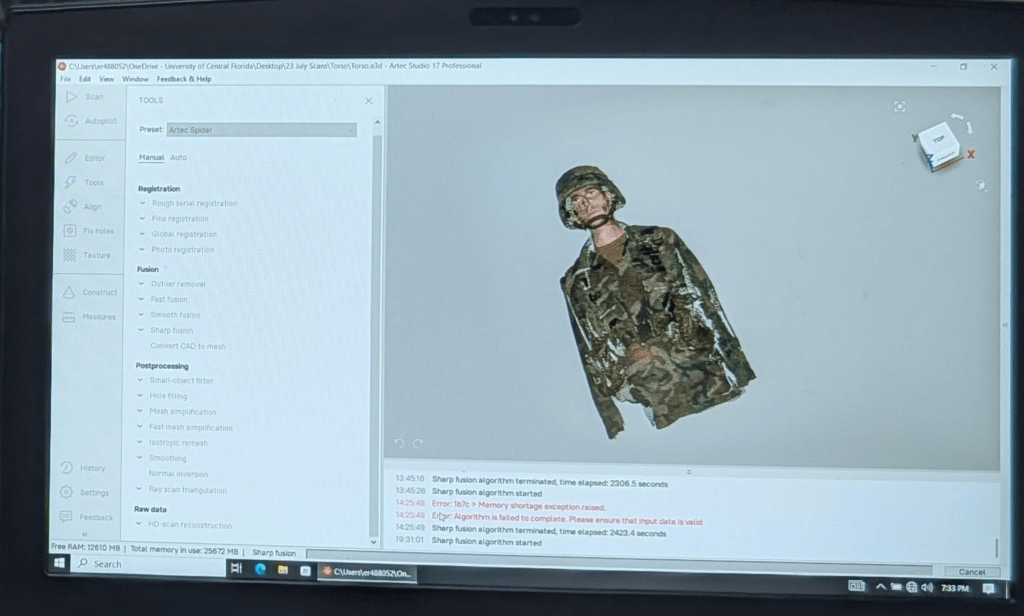
I will read some more about how I can de-corrupt my file in Artec studio. It appears that they have a few processes in place to do so. But it was going to be an absolutely massive file – something north of 10gb if not far more. For reference, the nurse’s cap above is ~45mb. I think I’ll be able to recover the file, and hope that I do, as I think there will be some procedural learning to be had from it.
Trent worked with the Sake bottle on Kiri Engine, and I’m curious about the results there. It was too highly glazed (and, thus, too shiny) for the Artec Spider to be able to “see” it.
 E.C. Thompson - Historian
Leave a comment