This week, Trent and I went to the BVMC and spent time moving through the space and taking note of the types of items which we think would be good candidates for digitization.
There are a mix of several criteria which I need to consider when choosing these items.
First, they should be things that I think I can successfully digitize via photogrammetry. This means that the item cannot be particularly shiny (as reflections/reflectivity can confuse the programs which align the photos in the process) and also cannot have areas that are too thin or spindly, as this can be hard for the program to recognize.
Another thing worth considering is that they should be objects that are worth the time investment to digitize. For example, while the museum displays numerous firearms, these may not be a good use of time. Many if not most of them have already been digitally modeled numerous times including, frankly, models that are likely better than I can produce. There is little utility in making the 3,745th model of a US M1 Garand to share on Sketchfab.
This math changes, however, if that particular item is unique – if there is an individual or story that goes along with it. The value of many of these objects is not inherent to the thing itself. Museologically, I’m rather uninterested in glass cases of old things saved purely because they are old – that’s antiquarianism, not public history. Instead, I’m interested in the sorts of stories we can tell using those objects and, in a more meta way, how we can tell those sorts of stories.
I also have a few, admittedly somewhat still fuzzy, ideas about the sorts of things I’m uninterested in digitizing. This, mostly, includes artifacts that are overtly racist and problematic. I’ve seen how models I have made of confederate monuments are shared in certain neo-confederate spaces, and do not particularly fancy running that same experiment with nazi paraphernalia. So, for the most part, if it prominently features a swastika, I’m not interested in making a publicly sharable and downloadable digital asset of it, even if it otherwise meets the rest of my criteria.
We walked through the museum with its curator, Ed, and shared the sort of things we had taken down as potential candidates. He now has a better feel for the sorts of objects we’re looking at, and is going to come up with his own list and we’ll go from there.
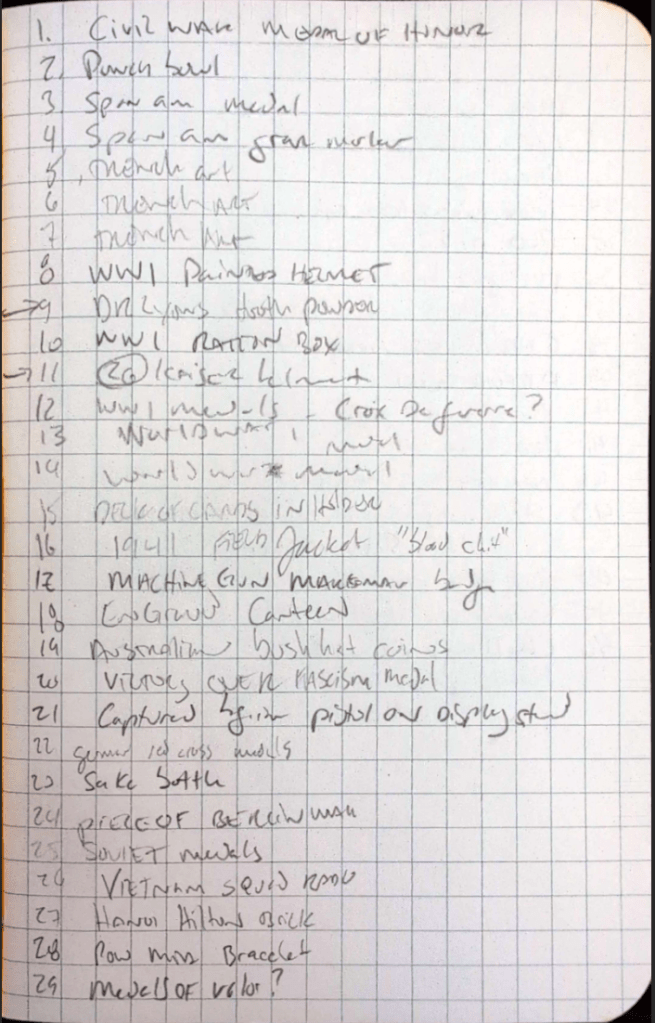
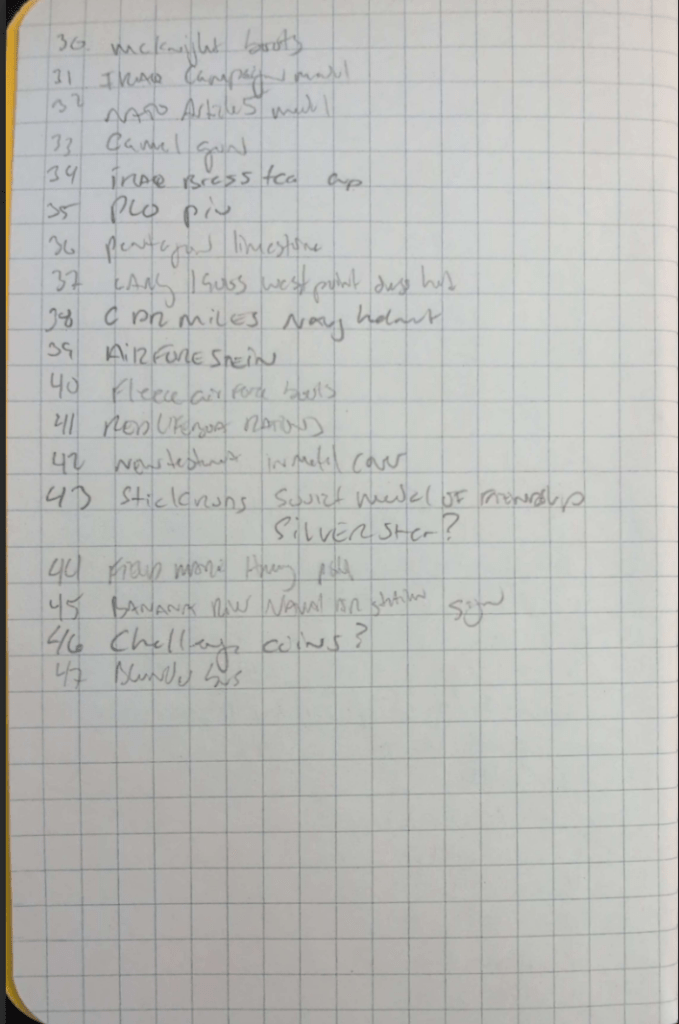
They have blocked out time for us in a meeting space which I will use as my photography and workspace starting on June 11th going forward.
In addition to the time at the BVMC, I spent several days this week working on figuring out a workflow for photography of objects. Most of my prior experience is of monuments via a combination of drone and cellphone photography. For this project, I will have better access to the objects and would like to photograph all sides of the objects (a monument, for example, you cannot photograph its base, so that side is always open or digitally modified to be closed in post-processing). Here, I would like to more faithfully reproduce the entire object.
This workflow will look a bit more like studio photography than field photography. I have secured a powered turntable, about a foot in diameter, which can hold approximately 100 pounds. This turntable can be programmed to automatically rotate a certain amount of degrees before pausing for a photograph, and then continue in this fashion until a complete revolution has been completed. Working this way will let me take photographs in a more controlled fashion.
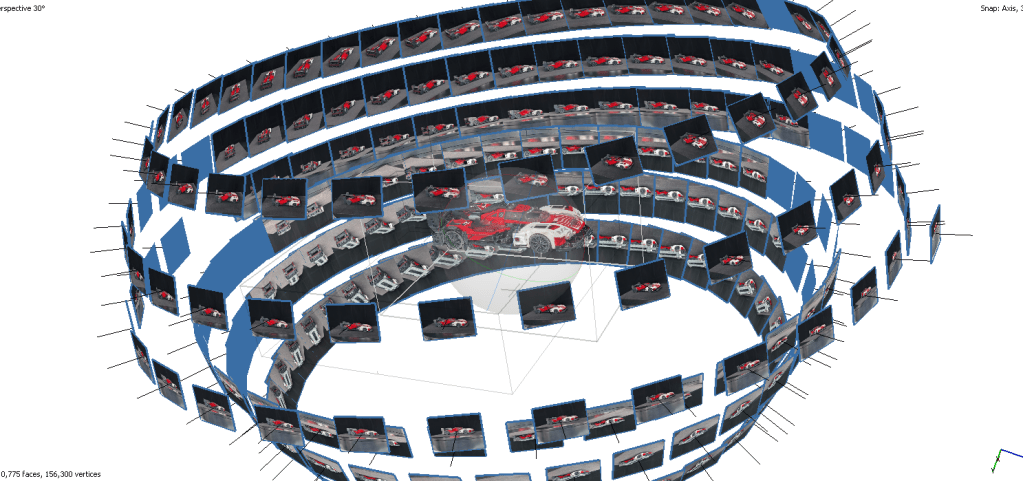
Agisoft Metashape, the program with which I am most familiar, allows a turntable based workflow, where some other programs may not.
For the moment, I am creating a relatively low budget studio-style workflow which included my cellphone mounted to a tripod, the turntable, a black velvet background on a t-stand, and a remote trigger for the cellphone’s camera. I am experimenting to to determine if additional studio lighting is required, or if ambient light is sufficient. If photography lights become necessary (to more evenly light the object and combat confusion from shadows), then I will need to switch away from my cellphone and move to a dedicated camera – perhaps a used DSLR camera and 50mm lens.
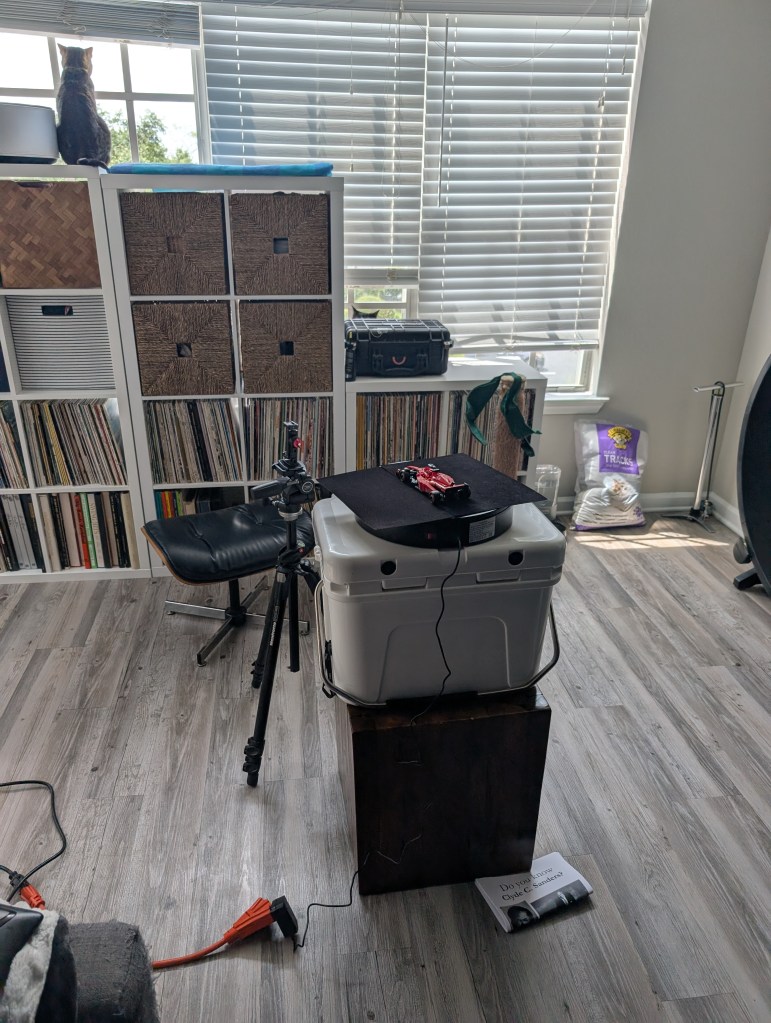
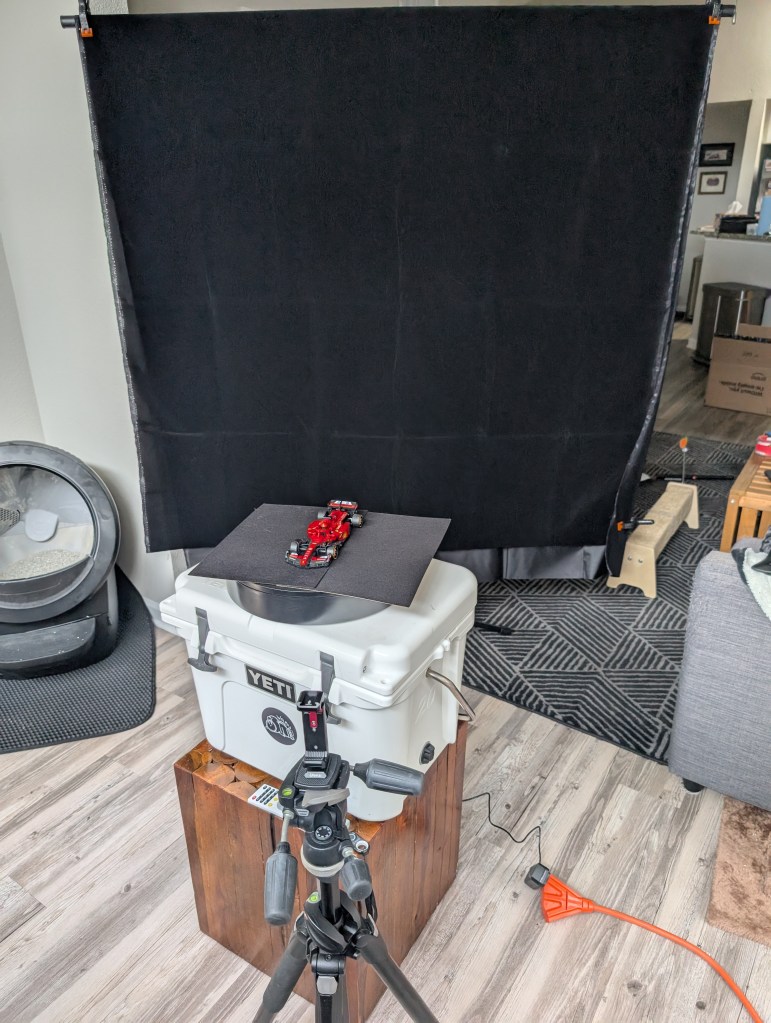
This workstation allows the turntable to be at a height that works for this tripod. The black background and mat on which the object is placed allow the program to better separate the object from the background. Contrast also helps with any manual masking of the image or editing out extraneous parts.
These two models, of Lego cars I had on my bookshelf, show the good work of the process – these cars are small, some five or six inches long, and details like individual Lego studs or small text on logos are fairly visible. The red car also shows the progress made in my learning how to mask off the object and create a better separation of the object from the mat on which I placed it. In particular, the nose of the car shows where I worked to create separation between parts of the car’s wing and wheel/ suspension components. In both cases, however, I have not sucessfully rendered the bottom of the car.
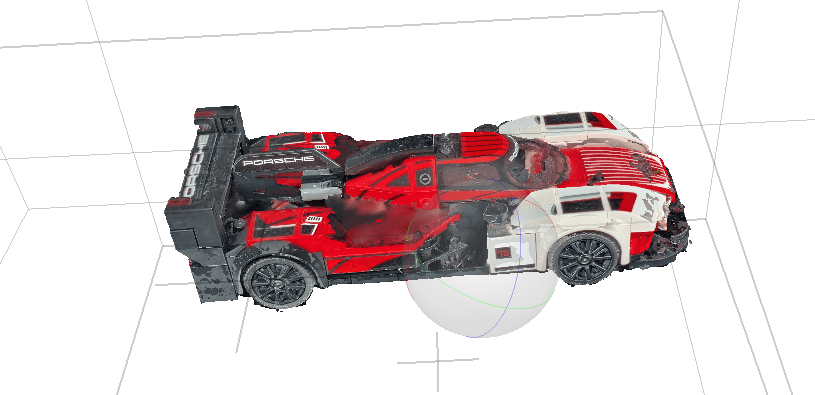
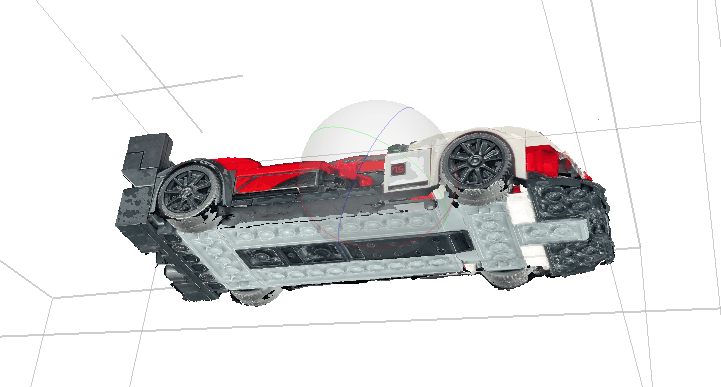
The above images of an additional model, which I am still working on, shows a moderately successful attempt at merging a model of the underside of the car with a model of the top of the car.
I currently have a license for the “standard” version of the program, but may purchase a license for the “professional” version of the program which has features that will make this process considerably easier.
The most relevant of these features is the ability to manually add “markers’ to multiple different models in order to merge them. In the above model, which I made in a demo version of Metashape Professional, I flagged the center point of each wheel and two spots on the tail of the car which appeared in the model of both the top and bottom half. This made the merging process much easier as the program had guidance instead of having to figure it out for itself. The model is still, however, rough because I did a poor job splitting the two halves. The demo version of the program also does not allow exporting. When I’m feeling more flush with cash, I’ll upgrade my license of the program now that I’m more confident it can do what I want it to do.
To that point of not feeling flush with cash, that brings me to next week. I will not be at the BVMC next week as on Wednesday we are closing on the purchase of our house. Trent and the folks at the BVMC are aware that we will not be there next week. My assignments for Trent next week will be a few videos I’ve found about turntable based photogrammetry workflows as well as a training session the history department has organized on Monday, June 2nd in CHDR about scanning and digitization. Unfortunately, I cannot make that meeting, but am looking forward to arranging a time to go back and catch up on what I’ve missed at it – I’m sure there is information they can share that will be very helpful for what I”m doing.
 E.C. Thompson - Historian
Leave a comment