The week started earlier, with my attending some work in Greenwood Cemetery doing ground penetrating radar on Saturday morning. As stated last week, this mostly served as a convenient excuse to bump into some folks from CHDR to start a conversation about getting some hands on experience with their Artec 3d Scanners.
This coming Tuesday (6/17), Trent and I are heading to CHDR for a few hours to do just that with Dr. Giroux. We’ll hopefully learn a little bit more about the Artec Spyder and Eva scanners that CHDR has.
This week at BVMC we spent the day photographing trench art. It was the first time I’ve moved and reinstalled my turntable photography set up. I think the process of set up and teardown will improve over time. Unfortunately, space is tight at BVMC, and the office we were given permission and scheduled time to use is normally used by Disabled American Veterans (“DAV,” a nonprofit established to help secure benefits for veterans with disabilities), so displacing them for a day a week ruffled some feathers in their organization. Further, it certainly makes me feel like a right muppet for booting disabled vets and a nonprofit volunteer trying to secure benefits for them.
That aside, the workspace worked relatively well for us, I think. It should also improve when we are next there, as this office was also the secure location where voting machines were temporarily stored after the recent Brevard Special Election – they took up quite a lot of room and sort of loomed over us.
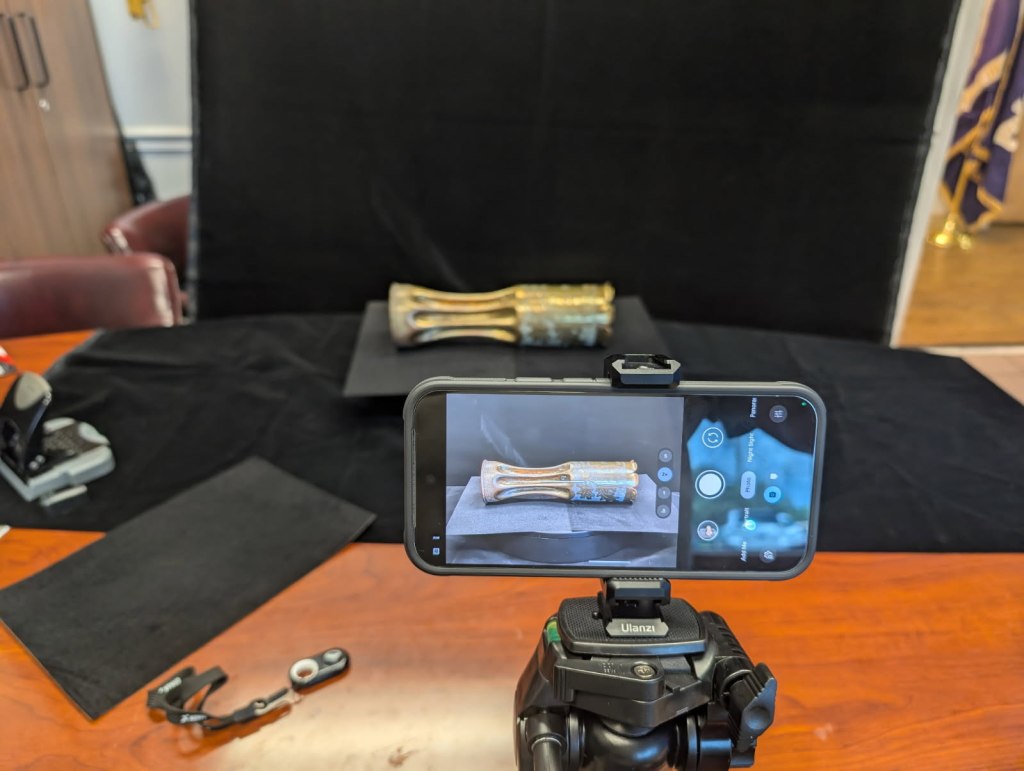
The first objects we worked with was a series of pieces of “trench art” created from modifying artillery shells.
We used the photography setup on four items. I took approximately 1200 photographs over the course of the morning and early afternoon over these four artifacts. I set the turntable to rotate, pausing 36 times along its way before it made a complete revolution (if my math is good, this means a photograph every ten degrees), essentially creating a ring of photographs encircling the object. I then moved the camera slightly higher and angled it downward and repeated. I moved the camera higher and angled downward one additional time and took another set of photos. We then flipped the object 180 degrees so that what was once its base was now up in the air and repeated the same multiple angles of photography. I then laid the objects on their side and took rings of photographs at two heights, and then flipped the object 180 degrees one last time.
The reason for additional rungs of photography besides the initial three views is so that all sides of the object can be captured.
The first piece of trench art we photographed actually did not have a base at all, so it only needed the three initial rungs of photography. This model is nearly perfect – there is one stray piece of data floating above the object, and then a few small holes near its base. I’ll re-run the modeling at some point and fix both of those. This piece of trench art is literally just a hollow tube with a spiked top and open on both ends.
I have made a rough model of the second piece of trench art we photographed, using only the first three rungs (original top view orientation) and have made a strong model from that. I will continue honing the process and practicing stitching subsequent views together.
This process has also drawn into clearer focus some of what I think I want to explore in my dissertation research.
I mentioned that we’re going to learn to use some of Artec’s 3d scanners. These would obviously be considerably faster than the photogrammetric process.
I also mentioned using Kiri Engine, a free app that processes the models via the cloud.
I think part of what I might work to do in my research is do some sort of A/B(and /C) testing asking viewers for their preference on models. I might make models of the same object using each method and then be able to run some sort of analysis that charts viewer preference (presumably a stand-in for quality) against time and expense to create them. Kiri engine is lowest (near free) cost and relatively low time, my photogrammetric process is a fairly high time commitment but still relatively low cost, and an Artec scanner is extremely high cost, but relatively low time.
The time commitment on doing these models is really quite eye opening. My rough estimation is that it takes approximately 4-5 minutes to do the photography of a single “orbit” including turning the object. So if you’re taking two or three orbits per orientation, and you’re doing three or four orientations that can add up. Twelve orbits of five minutes a piece would be an hour of photography per item at high efficiency, with then multiple hours of post photography processing, file management, and computing work to create the models shared above. The first trench art model is something like five hours of work, and it was likely the most straightforward of the ones that I will produce.
To the point of file management, the ~1200 photographs I took on Wednesday was about 80gb of data, which certainly took some time to extract from my cell phone and organize onto my computer, and I’m not particularly certain I carefully tracked the time to do this. Something to keep an eye out as I go forward is carefully tracking time. I may bring a stopwatch next time we do a day of photography.
That said, I’m pleased with the models I’ve made so far, and am even more pleased that some of my research methodology and process might be, if not coming into clear focus, at least no longer a fuzzy speck beyond the horizon.
 E.C. Thompson - Historian
Leave a comment